Priests of the Sacred Heart/US Province
REIGN OF THE SACRED HEART
  • About Us
    • Learn More
    • Fr. Dehon >
      • Who Was Leo Dehon?
      • Fr. Dehon and "The Social Question" (Part 1)
      • Fr. Dehon and "The Social Question" (Part 2)
      • Fr. Dehon and "The Social Question" (Part 3)
      • Fr. Dehon and "The Social Question" (Part 4)
      • Fr. Dehon and Politics
    • JPR Commission >
      • JPR Commission Members
      • JPR Public Letter
      • JPR Newsletter
  • Issues
    • Dual Threats of Climate Change and Nuclear Weapons >
      • Nuclear Disarmament Action Steps
    • Immigration >
      • USCCB on Immigration
      • Facts & Numbers
      • Immigration Resources
      • Immigration Archives
      • Migration Education Resources for Parishes
      • A Day Without Immigrants
      • Bible Today Article on Migration
      • What is "Sanctuary?"
      • CCMR Public Statement
      • Prayer for Migrants and Refugees
    • Climate >
      • Pope Francis' Climate Address
      • Dakota Access Pipeline/Standing Rock Protest
      • Headlines
    • Economic Justice >
      • Catholic Framework For Economic Life
      • Economic Justice Facts & Figures
      • Stories of Poverty
      • Tax Justice
      • Seventh Generation Interfaith Corporate Responsiibility >
        • How Shareholder Resolutions Work
    • War >
      • Israel-Palestine Conflict
      • Syria
    • Racial Justice
    • Health Care
    • Human Trafficking >
      • Headlines
  • Advocacy
    • What is Social Justice? >
      • Frequently Asked Questions
    • What is Advocacy
    • Why Advocacy
    • Ways To Be An Advocate
    • Recognition >
      • 2020 Klingler Award : Fr. Michael O'Brien and Sacred Heart Parish, Canton, MS
      • 2020 Klinger Award: Frank Wittouck, SCJ
  • Blogs
    • JPR Blog
    • Bob Bossie SCJ Blogpage
    • CCMR Blog
    • Commentary >
      • General Comments
    • SCJ Survey Results
  • Resources
    • Catholic Social Teaching >
      • Basic Principles of Catholic Social Teaching
      • Scriptural Foundations >
        • Old Testament Foundations
        • New Testament Foundations
      • CST Quiz
      • Social Ministry Glossary of Terms
    • Social Ministry Resources
    • Links to Other Sites

April 10th, 2018

4/10/2018

0 Comments


SO IT SEEMS TO ME – An Occasional Reflection by Bob Bossie, SCJ

Care for Creation: A Spiritual Activity

Stephen Hawking has died. The renowned astrophysicist lived the last thirty years of life almost fully paralyzed, but fully committed to the understanding of the world we inhabit in all its wonder. His life was a great benefit to the whole world including the world of faith, not just astrophysics. Recall that Thomas Aquinas reminded us that the natural world was a reflection of the living God.  Hawking, unwittingly or not, pushed that revelation to new levels. I believe he helped us to understand better how God is present in and continuing the act of creation even now. This casts our care for creation in even deeper spiritual levels than we might have thought.

Standing on the shoulders of Newton, Einstein and other such luminaries, Hawking furthered what I call science as another form of mysticism, in ways that are more understandable to the average person. His book A Brief History of Time, which sold over ten million copies in twenty years, is testimony to his impact. For me, he also stood on the shoulders of people like Fr. Dehon who instructed us to stand in the world with the bible in one hand and the newspaper in the other; that is to say, so as to be able to show the presence of the living God in our daily life and the whole material world and universe as well. Thus, the work for justice and care for the earth are not just utilitarian. They are, essentially,  spiritual activities.

This might seem a strange conflation of persons and facts especially since Hawking said he did not believe in God because he found it unnecessary to postulate a god when science could explain the natural phenomenon more than adequately enough. But, in so doing, he pushed the image of God even further than many God-worshiping persons have done. While we may believe that such thinkers as Hawking and those who are more secular in their views denounce or diminish the living God, they are saying to us that our God is not enough for them. That there must be much more than the One we tend to worship and preach or there is no God.

I personally had such an experience years ago. I lay on a couch in a friend’s basement apartment in Hollywood, California and decided to stop participating in the world unless I could find a reason to do so. I thought of the many persons who were close to me, including my dear mother, but they were all insufficient. I thought of the God whom I knew at that point but I was forced to say, “I am sorry. You are not good enough.” I thought all the way back to my birth but could not think of any reason to continue. I was about to quit when I thought, what about before you were born?

In a flash, I thought of my conception. At that very instant, all I “heard” was “God.” The word “God.” And at once I was immersed in this God beyond any understanding or words or time. I could not distinguish in any way the difference between myself and God. I was fully and completely lost in this state of being God. This God and I were one to the extent that I was God. I no longer existed. Only God. Then I knew that I was holy, good, lovable and worthy of reverence as were all other persons, creatures and things because they too were in and of the living God. This interconnectivity of all being is the ground for the work of social justice and care for creation.

It is for this reason that I have come to believe that atheists, agnostics and secularists are pushing us beyond our preconceived notions of God. I know that most often they don’t actually say these words but, to be honest, that is their message to us, we believers. And this is most challenging to churches and its members because it calls into question, yet again, the God we profess and the divisions we create in our world. Yet, did not Jesus do the same thing, that is, call into question the image of God and the social and religious divisions as was then being proclaimed?

I heard an SCJ friend say, years ago, that Jesus’ contemporaries knew he was human. They had trouble knowing he was divine. It might be said the opposite today. We “know” he is God but we have real trouble understanding he was human, like ourselves. Jesus’ incarnation revealed, yet again, that all of creation, including we humans, are in and of the living God.

In this same tradition of Jesus, Aquinas, Hawking and secularists, Pope Francis has embarked on a similar journey by calling into question the manner in which many people of faith view God’s presence in the natural world, that is, as a throw away reality. For those persons, the natural world is here simply as a conveyance for our temporal existence and not of value in and of itself. This can be said to be true, it seems, as evidenced by our behavior toward all other creatures large and small and the earth itself. They are here for our convenience.

In his encyclical on the environment, Laudato Si (On Care for our Common Home), Francis teaches us that the natural world, of which we are a part, is a real and tangible manifestation of the living God and, by necessity, worthy of love and reverence. Otherwise, the incarnation of Jesus, the second person of the Trinity, is merely a good story with no real roots in reality.

Is it any wonder, then, that Pope Francis chose St. Francis as his namesake?  For it was St. Francis who spoke of Brother Sun and Sister Moon. Though these words are merely allegorical in some person’s minds, Pope Francis and other mystics, including Hawking, have shown this interconnectivity is the nature of God’s universe.

It seems to me that God is now using persons of science and religion to push us beyond our preconceived notions of God’s own self and the false divisions within society to a new level of what it means to live in community in harmony with all creation. Might I be so bold as to call them prophets or apostles of the living God? They remind us that God cannot be confined to our concepts however good and honorable they may be. For the living God is ever yet to be met anew, each and every moment of our lives. And we are invited to live this union to which we are being exposed ever more clearly each every day.
So it seems ever more clear to me that the works of science, social justice and care for creation are, essentially, spiritual activities.
0 Comments

SO IT SEEMS TO ME – An Occasional Reflection by Bob Bossie, SCJ

3/13/2018

1 Comment

 
FATHER DEHON'S CALL FOR UNITY IN TODAY'S WORLD
It does Trump opponents no good to disparage Trump supporters. Or for Trump supporters to disparage those who oppose his policies. Nor does it do Trump supporters any good to disparage immigrants for taking jobs, draining our social and education programs or focusing on immigrant’s, so called, criminal activity such as coming here illegally, bringing drugs or acting as terrorists.

To do so plays, intentionally or not, into the very goal of those who benefit most from this division: to divide and conquer. In doing so, the real beneficiaries of such tactics reap enormous profits, wealth and control while the rest of us fight each other for the scraps that remain.

This is not a new phenomenon. Fr. Dehon himself, grew up and ministered in the early stages of the industrial revolution which wreaked so much havoc on so many and the environment. In this unregulated, free-market environment, Fr. Dehon became the apostle of social justice, one who spoke for the downtrodden and dispossessed. Regrettably, this system has maintained its prominence, albeit with minor regulations, up to the present day.

However, beginning in 1970’s the oligarchy in the U.S. began to work to convince Americans that government was the cause of all that ailed us, and unfettered capitalism was the solution. In addition, they cut taxes (especially for themselves and corporations) and social programs and gave vast fortunes to weapons makers and for wars. Such continues to this very day. This has made it ever more difficult for government to find the resources to pay attention to the common good.

THE TRUMP ERA
The Trump ascendency is the culmination of this strategy because it radically alters the balance of power and solidifies the presence of what now must be called “the corporate-state.” This corporate-state is poised to set in stone the divisions in our society and the control of our common life which will close the political space from which many, like Fr. Dehon, have struggled for so long to achieve even modest gains. While the mainstream media distracts us by focusing on Trump’s state of mind or his tweets and constantly changing positions, in the background, political-corporate leaders are busy reshaping the country and the world in a morally misshapen image. Some say we are moving inexorably toward “neo-fascism,” that is, wherein all power resides in this corporate-state.

Trump supporters, many of whom are “the forgotten majority”, “traditional Americans”, and those who pay taxes but reap little benefits of the “welfare state”, have been gradually manipulated into the role of apologists for the corporate-state and its rulers. Meanwhile, Trump opponents play their assigned role by impugning Trump supporters, enjoying the benefits of the status quo and look for the day when Trump can be voted out or impeached and we can return to the hey-day of the real America -- as if that would really make the difference. Those who insist upon the continuation of the welfare-state ensure, by default, the continuation of the status quo.

All the while, the real culprit, unfettered capitalism, lurks in the background, ever ready to shift tactics, as the time demands, through the efforts of its priests, minions and pundits.

UNFETTERED CAPITALISM
I am not speaking here of the “mom and pop” type capitalism if such ever truly existed. Moreover, I recognize that, for many, capitalism seems to be a very beneficial system creating wealth, development and the reduction of poverty, to name a few such benefits. And, yes, I know that many if not most persons acknowledge its flaws but see no other alternative.

When viewed more closely, however, we can see that unfettered capitalism or monopoly capitalism is the world’s dominant economic order. It is ruled by mega-corporations and their political partners, pays allegiance only to itself, transcends every nation and seeks to devour all competitors.

This capitalism has a life of its own, demands obedience to its tenets and richly rewards those who have learned to do so. And we, the majority, who comprise the victims of this social and economic system, pay our homage to those who succeed under its tenets and imagine the day when we too will sit in such exalted places, perhaps dolling out our charity to the deserving poor.

Unfettered capitalism is based upon three very seductive, fundamental tenets which we worship and give our very lives, intentionally or not:

  1. Everything is a commodity, subject to the demands of the market and the insane drive for maximum profit. This includes human beings and all earth’s creatures large and small. Now, with sights on colonizing Mars, this includes all of the solar system, the universe. 

    Catholic Social Teaching, however, stresses the life and dignity of every human person living in community and in harmony with creation.

  2. Private ownership is the ultimate sacrament. Expansion and control of this ownership is the absolute necessity. Expand or die. Competition over ownership and markets is foremost. Inexorably this leads to the concentration of ownership and wealth. There is no real concern for the common good or for our common home, the earth.

    Pope St. John Paul II teaches us that capital is not an absolute right but is at the service of labor and the common good.

  3. Capitalism, by necessity, is a global system which cannot bear any opposing systems. Thus it proceeds through domination by corporate-imperial states. Today, this means the threat of nuclear annihilation.

    Catholic Social Teaching instructs us that cooperation and communion are key to a healthy future.
Viewed from this perspective, this capitalism is the true "original" sin: a structure created by us which has assumed a life of its own and in which we have grown accustomed to eek out some semblance of humanity. In the end, however, it subverts our very souls, controls our destiny and brings death and destruction to all. And we allow it to do so for many reasons large and small.

It is crucial for us to realize that Jesus’ execution by the revered institutions of church and state became, by his nonviolent, self-offering love, an expose of the fundamentally violent basis of all institutions. Thus was the sin of these institutions revealed and their downfall begun. Hence, Fr. Dehon calls us to work for the reign of this Heart of Jesus in Souls and Society.

WHERE DO WE GO FROM HERE?
Our goal is to recognize and oppose the divisions fostered by this system itself which, as I said earlier, has reached a new level of depravity, has a life of its own, and which lures all into its web. Fr. Dehon advises us that our common goals must be sint unum (our unity) and adveniat regnum tuum (the reign of the Heart of Jesus in Souls and Societies). We must find ways to work in harmony with one another to change, as Dorothy Day would say, this “filthy rotten system.”

Is some form of socialism, as practiced in many developed countries, an answer? Perhaps. Is capitalism inherently flawed? Carried to its present logical extreme, Yes. I am very skeptical that this form of capitalism can ever be regulated to the point where it is not a grave threat to many persons in the world and the earth itself.

At this critical moment, which is marked by the fusion of the political and corporate structures, we must work to reclaim our communion with one another and the earth of which we are part. Not to do so is to lose the little political space we have which has been carved out by such luminaries as Fr. Dehon. We must do everything in our power to help everyone, including the champions of this system, to step back from the brink of ecological and nuclear extinction and to find another way based upon the common good, care for all creatures large and small, and the earth which sustains us.

Or so it seems to me.

1 Comment

Some Thoughts on Lent 2018

2/9/2018

0 Comments

 
by Bob Bossie, SCJ

The traditional Lenten themes of Almsgiving, Prayer and Fasting call us to a deeper relationship with God, God’s children and God's earth.

Almsgiving
Chalana stopped me in the park a few weeks ago. I have known her since she started coming to our community house for help several years ago.

We talked for a while. I gave her some money to help her with her needs.

She then told me that the government removed from the approved list of medicines the only medicine that helped her psychological needs. She didn’t know what she was going to do. Then, she told me, to make matters worse the government was also closing most of the mental health clinics in the city.

Prayer
I couldn’t find the words to respond to her except to say I knew about the closings already. Deep inside I felt the anger rising at such injustice against the most vulnerable.

The words of Rev. Cornell West came to mind: “Never forget that justice is what love looks like in public.” 

The 1971 Synod of Catholic Bishops said as much in their document Justice in the World: “Action on behalf of justice and participation in the transformation of the world fully appear to us as a constitutive dimension of the preaching of the Gospel, or, in other words, of the Church’s mission for the redemption of the human race and its liberation from every oppressive situation. [#16…. [U]nless the Christian message of love and justice shows its effectiveness through action in the cause of justice in the world, it will only with difficulty gain credibility.” [#35] 

Father Dehon, founder of the Congregation of  Priests of the Sacred Heart, of which I am a member, said it well: "Charity is a palliative which is always welcome and often necessary; but it does not attack the root of the evil" (Social Works vol. 1, p. 366)

Prayer
    where we stand naked before God
        allowing
            even inviting
    our soul to be tested
        to be refined in fire
        
    to be shown things
        we’d rather not see
    to be presented with a vision
        too wonderful to attain
    yet, which ignites our hearts
        in unexpected ways.

Prayer–
    tests and refines
    our allegiance
    
    now
        flag
        nation
        family
        culture
    are no longer sufficient
        to claim our loyalty

    but the living God
        who sends us out 
            again
        to subvert
           redeem
        all that we touch
            including our own hearts

Prayer is a subversive activity.

Fasting
For me, fasting has at least two elements to it.
First, when we fast from some or all food for shorter periods, we have chosen to live a little more closely with those who struggle each day for their daily bread. 

Gandhi’s words are poignant here: 

“It is good enough to talk of God whilst we are sitting here after a nice breakfast and looking forward to a nicer luncheon, but how am I to talk of God to the millions who have to go without two meals a day? To them God can only appear as bread and butter.”
Second, and this is connected with the first element. When we fast, we are not only offered an opportunity to stand in solidarity with the oppressed, but we are also invited to work with them in creating  the beloved community living in harmony with all creation. Clearly, hope is in such a struggle.

Dorothy Day -- founder of the Catholic Worker community, and identified by Pope Francis as a model for us in the USA when speaking to the U.S. congress -- acknowledged that “Love in action is a harsh and dreadful thing compared to love in dreams.” 

Again Pope Francis: “I prefer a church which is bruised, hurting and dirty because it has been out on the streets, rather than a church which is unhealthy from being confined and from clinging to its own security.”
The traditional Lenten themes of Almsgiving, Prayer and Fasting call us to greater solidarity with God and with those who are poor and oppressed, including the earth itself which sustains us all.
Or so it seems to me.

0 Comments

Students at Sacred Heart School get lesson on immigrants

1/16/2018

0 Comments

 
By Mark Peters, U.S. Province Director of Justice, Peace and Reconciliation

Allison Baskin is a Religion and Spanish teacher at Sacred Heart School in Southaven, MS.  Last year, she heard me speak at the Mission Conference about our “post card campaign” to get Kohl’s and Macy’s to carry fair trade clothing, and took a bunch of post cards to use with her 8th Grade religion class.  She wanted to help them see the connections between what they wear and social justice for Third World garment workers.

This year, she asked for more post cards, but I had to tell her that there was no similar campaign planned this year.  I mentioned, though, that the Priests of the Sacred Heart in the U.S. and Canada were involved in related justice issues like immigration and climate change, and offered my assistance if she wanted to work up a lesson plan on one of those issues.

She was intrigued by the immigration issue, which of course has gotten so much attention in the last few years, so I sent her some background info and links to other resources.  In short order, she was back to me with a lesson plan she put together herself that incorporated Catholic social teaching on the subject, a review of current U.S. policy, and many interactive exercises and reflection questions designed to get students to think seriously about this issue that so many adults struggle to understand.
I was so impressed by the whole lesson plan, which stretched over several days, that I asked Mrs. Baskin if we could share it with other teachers in SCJ-run schools.  She graciously agreed, and it was included in a set of parish resources that went out to SCJ pastors this past summer, and with folks involved in immigrant justice work in the Archdiocese of Milwaukee as well.  Those resources, including her lesson plan, can be found here.

Last month, Mrs. Baskin and her class completed the lesson plan, and I asked her to share her reflections on it.  Here are her thoughts on the project:

Immigration has been a hot topic for the past few years in our society, and I bring it up in my Spanish classes every year when we discuss Cinco de Mayo and other holidays Latinos have brought here to the United States.  This fall, I taught an in-depth unit on immigration concentrating on Catholic Social Teaching along with saints connected to immigration.

I started by asking students what they knew about immigration, and as you would imagine, their answers were pretty much what you hear in the media and from various people when the subject comes up in conversation.  They usual responses ranged from, “immigrants come illegally here and bring drugs” to “they take Americans’ jobs” and even “that’s how terrorists come into our county.”  I asked what they wanted to know about immigration and tried to answer their many questions while teaching them about Catholic Social Teaching and US policies on immigration. 

The students really had empathy when looking at various pictures of immigrants in tough situations.  They showed compassion after listening to stories of families torn apart by deportation.  They offered ways they could help immigrants today, including those they may never face.  We discussed various reasons people immigrate and how Jesus, Mary and Joseph themselves were immigrants when they had to flee to Egypt to escape Herod.   A guest speaker discussed the struggles she faced when she first emigrated here from El Salvador.

The question arose about why immigrants aren’t learning to speak English and I put the question back to them.  Since I have been teaching many of them Spanish once or twice a week for the past 9 years, I asked how many of them had the language skills needed to live in a Spanish speaking country successfully.  They all agreed that they didn’t have that knowledge which shows how long it really takes to master another language.    We took a practice citizenship test online together and the majority of the class made 70 or below.  No one scored higher than a 90 – including myself!  I think they really realized how difficult it is to come here and how long it takes when they do it following all the rules.  They now know how many of them feel forced to leave due to terrible conditions or fears, and how many just don’t have the time to go through all the channels and every right step when they have children and other family to protect and feed. 

It was an eye – opening lesson for the students and me as well when I was researching it.  There were so many stereotypes to debunk and Scripture and Catholic Social Teaching to address while trying to keep it on an 8th grade level.  I hope they can continue to show compassion and empathy towards people who come to this country searching a better way of life.

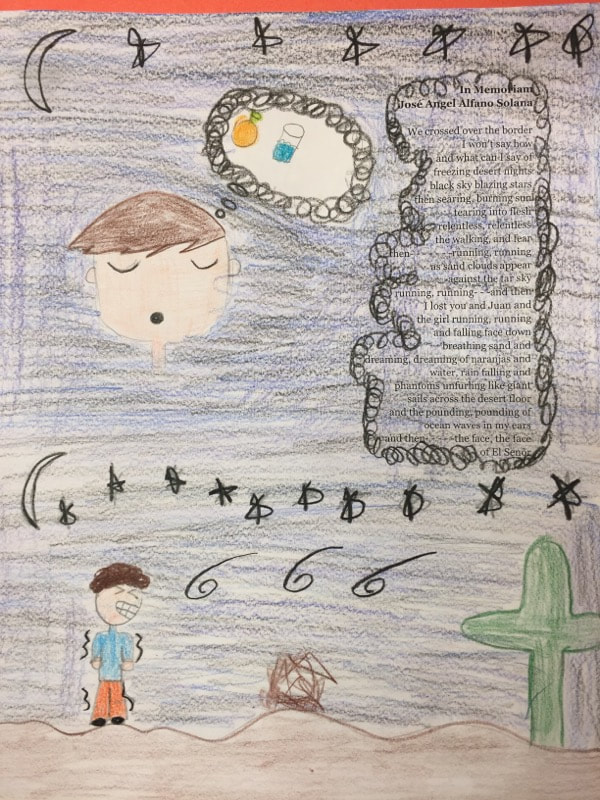
The school took some video of the class sessions that can be seen here, here, and here.  What stands out for me in all of these videos is what a lesson in empathy these students received!  At one point, they watched a video of a boy their age describe his harrowing journey to the U.S. and the fear that comes with not having “papers” and being seen as an “illegal,” even though lack of papers is merely a misdemeanor and the Church reminds us such terms are slurs on the sacred dignity of every human being.  The students came to understand the forces that drive families from their homelands, and over and over were asked to “stand in the shoes” of migrants.  They were asked to reflect on times when they didn’t understand a language or culture, or felt like strangers in need of welcome.   Below is a picture one of the students drew as a class project.

Many thanks to Mrs. Baskin for her efforts to help her students better understand this issue and the people it affects.  I hope other teachers will use her lesson plan, and that we can expose more young Catholics to this important social justice issue.
 
Picture
0 Comments

SO IT SEEMS TO ME:  An Occasional Reflection by Bob Bossie, SCJ

12/11/2017

2 Comments

 
Welcoming the immigrant: It’s Not Just Charity -- It’s Justice

Many persons rightfully argue that we should welcome immigrants because it is the Christian, human or charitable thing to do. In fact, Christians call it a corporal work of mercy. But this position misses an essential point: It is our responsibility in justice to support and accept them. Please let me explain.

Many immigrants come to the U.S. from Mexico or Central America. They give up their whole way of life and leave their families, homes and neighbors because conditions there are impossible due to policies beyond their control.  For example, for years poor Mexican families eked out a living on small family farms. They lived off of the nourishment they enjoyed from the corn they grew while selling their surplus on the open Mexican market so they could have some money to buy other essentials.  

In 1994, the U.S., Mexican and Canadian government signed the North American Free Trade Agreement (NAFTA) which, basically, created open borders between these three countries. As a result, the huge, corporate corn-producers in the U.S. exported their grain to Mexico tariff free. This drove down the price of corn in Mexico. Furthermore, these U.S. producers benefit from U.S. government farm-subsidies which allow U.S. producers to sell their corn in Mexico at an even lower price and still reap profit.  Thus, Mexican subsistence farmers were unable to compete in their local markets and lost their ability to sell their surplus corn at a fair price. Many fled to their cities to seek work to little or no avail. Finally, in desperation, they made the long, arduous and very dangerous journey to the U.S. seeking a better way of life.

Another example may be found in the migration from Central America to the U.S. of tens of thousands of unaccompanied minors. The U.S. response, under Obama it might be noted, was to put them in prisons and deport them.  But why did they come here?  Many are fleeing the highly armed gangs which formed following the end of the U.S. backed “dirty wars” of the 1970-90s. During that period, the U.S. supported ruthless dictators in El Salvador, Guatemala and Honduras, flooded those countries with U.S. weapons, and destroyed society in general. The resulting chaos created a vacuum which is now filled by large, violent gangs who are well-armed with those very same U.S. weapons.  In fact, these countries are three of the ten most violent countries in the world.  Many young persons in those countries now flee these conditions and come to the U.S.

Escaping these unsafe and unlivable conditions as well as seeking a better way of life are often referred to as the “push–pull” causes of immigration. Rather than disparage these refugees, our sisters and brothers, it’s time we acknowledge the responsibility of the U.S. and other western powers for their plight, welcome them to our country and work to change the policies that drive them here in the first place.

Welcoming the immigrant is both an act of charity and justice.

Or so it seems to me.

2 Comments

SO IT SEEMS TO ME                                                    by Bob Bossie, SCJ

12/7/2017

0 Comments

 
True Human Community:  A Civilization of Poverty

Many persons pursue upwardly mobile lifestyles, that is, they try to move further and further from poverty by having more and more wealth and a higher and higher social status. But, we should strive to live a downwardly mobile lifestyle in order to be poor. Please let me explain these seemingly bizarre words.

The Earth does not have sufficient resources for everyone to live like many North Americans or their counterparts in other areas of the world. Since a first-world society of abundance cannot be universalized, it is not and cannot be moral.  Read more...

Just consider that one fifth of the human community, which includes those of us who are middle class, live a “champagne” lifestyle when compared with the other four-fifths -- the vast majority of whom are children – who live in poverty lacking the minimal levels of life’s basic necessities. Approximately, one billion of those in poverty live in extreme poverty.  More accurately, they live in misery. These children of God pass each day with little if anything to eat, nowhere to lay their heads, subject to the ravages of disease of every kind. Moreover, members of that top one-fifth of the human community pollute the environment, it is estimated, 15-70 times more than their poor counterparts. This is not the “blessed” poverty spoken of by Jesus.

The solution is a Civilization of Poverty, true poverty, wherein each person has what they need. Pope Paul VI said it another way: “No one is justified keeping for their exclusive use what they do not need, when others lack necessities.” Others have said, live simply so that your sisters and brothers may simply live.

This point of view totally turns our understanding of the world on its head. Whereas we are accustomed to speak of the wealthy, the middle class and the poor, we must now come to speak of the wealthy, the poor and those in misery. All persons must live a life of poverty, using only what they need.  This poverty can enable all of us to have access to some material and cultural goods which would make for a truly human life. To live a life of wealth or misery is contrary to the Gospel, what it means to be human.

From this understanding, the words “blessed are you poor, the reign of God is yours” (Lk 6:20) are a very practical spirituality and way of life for all people. In fact, it is an absolute demand in today’s world.

In this Civilization of Poverty, we will come to realize it is better to live as poor people who are energized with creativity, celebration, community, faith and hope, while living in harmony with all of creation, rather than living a life of routine, individualism, selfishness, pure pragmatism, resignation and passivity. We will find meaning in who we are and how we share with one another rather than by seeking more and more possessions. We will come to know, as Pope John Paul II instructed us, that our daily labor, of whatever kind, is a partnership with God’s ongoing creative activity, not subservient to capital as it is today.

While few persons welcome the Civilization of Poverty, including those who take a vow of poverty, it is the solution and ideal for today’s world.

Or so it seems to me.

Source: The Jesuit Martyrs of El Salvador: Celebrating the Anniversaries,
pp. 103-5

0 Comments

SO IT SEEMS TO ME – An Occasional Reflection by Bob Bossie, SCJ

10/30/2017

0 Comments

 
Changing Systems: It’s The Charitable Thing To Do

Many persons rightfully argue that we should act with charity toward those who are poor because it is the Christian and human thing to do. In fact, Christians call it a corporal work of mercy (feed the hungry, house the homeless). It is essential if you want to be Christian, they say. But this position leaves out a very important part of charity. Charity requires of us to also work to change those systems that keep people poor. Please let me explain.

I love my brother Paul very much. He is struggling with many health problems which require that I frequently take him to the local county hospital which, of course, is the brotherly, human or Christian thing to do. But recently, changes in social programs have resulted in cuts in hospital staff and services threatening Paul’s care and that of many others. What then does it mean to love my brother, and others, if not for me to also engage, as much as I am able, in addressing the social structures that control these funding cuts. As Cornell West said, “Never forget that justice is what love looks like in public.”

Of course, there are many social structures that need changing but the biggest obstacle is that we all grow comfortable with social structures just as they are. The more comfortable we are, the less need we feel for change.
 
Father Dehon, founder of the Priests of the Heart of Jesus, saw the need to address our own acceptance of unjust structures when he called for the “Reign of the Sacred Heart in [both] souls and societies.” Changing unjust structure is a spiritual activity.
 
This is why working for social justice can be controversial. If we respond to ozone depletion by giving direct aid (nursing the skin of cancer victims) nobody would object. But if we work to pass and enforce laws to eliminate the chemicals that deplete the ozone, some companies and investors are sure to oppose us.  Now deceased Archbishop Camara of Brazil acknowledged this obstacle, “When I tried to help the poor, people said I was a saint. When I asked why they were poor, people called me a communist.”

On the other side, while direct service is needed to help those most affected by unjust structures,  such service might also challenge unjust structures. For example, providing direct service to immigrants (food, clothing, shelter) can be a challenge to the assumptions and the structures that say immigrants are taking jobs from U.S. citizens. Or, befriending a person from the Middle East can challenge the assumption and structures that say you are aiding the enemy. Such direct service offers us the opportunity to educate ourselves and others as to the true causes of immigration, prejudice, war and other injustices. In fact, the true charity of which I speak demands this of us.
 
Thus it can be said that true charity requires direct service and work to change systems.

Or so it seems to me.

Note: Herein, I have freely quoted from “Justice and Charity” by Jim Dinn

0 Comments

It's All Connected, and That's Why It's Overwhelming

3/31/2017

2 Comments

 
Every day my biggest challenge is not sending another email or update or alert out to someone.  Important new developments, urgent action requests, and thoughtful pieces of analyis arrive in my inbox or newsfeed on almost an hourly basis, but I have to rein in my urge to share everything because I know no one else has my "luxury" (or is it a curse?) of focusing on these things as their job.  Still, despite my best attempts at restraint, the biggest complaint I always hear is that I put out too much.  The second-biggest complaint is probably how overwhelming it all is, both in terms of complexity, numbers of issues, and the average person's lack of relative power to do much about any of them.

The truth is it overwhelms me too.  For the reasons just mentioned, but also because over the last 40 years I've come to see just how connected every issue is to so many other issues.  That's what makes it hard to "focus like a laser beam" on only one or two issues, which is what the JPR Commission and I have agreed is a realistic goal for the coming couple of years.  But immigration is connected to poverty and the criminal justice system, and climate change is related to environmental regulation which is related to job creation, and now it turns out migration is being driven more and more by climate change, and it's all related to why wars are fought and why our military budget is so high... you get the picture.

It is overwhelming, but we can't afford to ignore those connections any more than politicians can ignore social media, or business can ignore new technologies.  A good example is what has been happening in Iraq under our military invasion, occupation and continuing intervention, and what has been happening in Syria under Assad and now US and Russian military intervention.  Their populations have been devastated, with hundreds of thousands dead and millions maimed, traumatized or displaced, and their refugees clog the makeshift camps at so many countries' borders.  The bombs dropped and fuel used by the military, and oil wells burned by insurgents all have wreaked havoc on the environment far beyond shattered buildings, leading to poisoned water and exploding cancer rates. 

President Trump's proposed federal budget would make deep cuts in nearly every other area of government except for the military, which would get a big boost despite no specific mission requiring one.  The U.S. already outspends the rest of the world combined on the military, and its budget is over 60% of the discretionary federal budget (entitlements like social security and medicare are funded through separate taxes, not the discretionary budget).  It seems to me that until we realize that might makes neither right nor peace, and begin to take seriously the need to invest in people, jobs and preserving the environment, the underlying problems that contribute to climate change and the migration crisis will never be addressed.

Justice is related to peace which is related to reconciliation which is related to justice.  It's hard to care about one issue without having to pay attention to all of them.  But we also have to pick our battles, so while we won't stop caring or paying attention to other issues, our energies and actions will stay focused.

2 Comments

"If I had known how hard it would be, I never would have come..."

3/10/2017

0 Comments

 
Picture
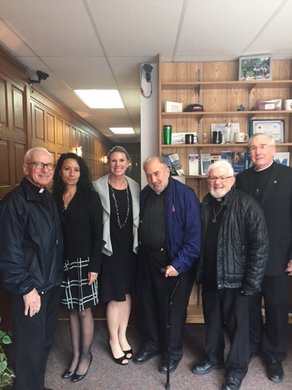
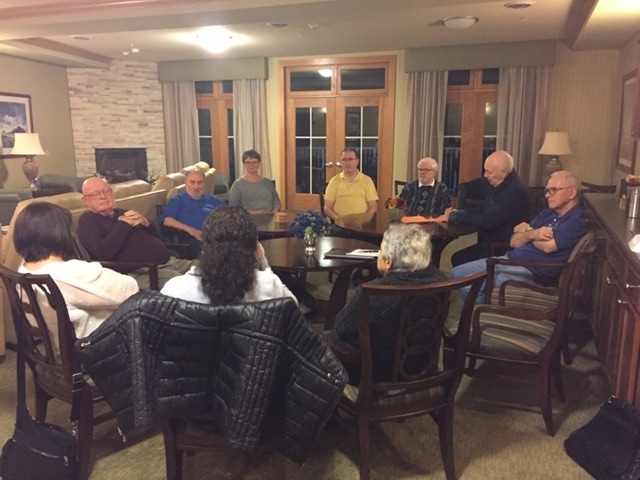
As policies that affect migrants and refugees have been at the top of the news since President Trump’s inauguration, so have SCJs been ramping up their focus on these policies.  On Tuesday February 21, five members of the North American Migration Committee were joined by five members of the local community at Sacred Heart Monastery at the Lake to hear the stories of two women who are active with Voces de la Frontera, a Milwaukee group that organizes undocumented members of the Latino community and their allies around the state.  Then this past Monday, Frs. John Czyzynski, Tony Russo, Paul Casper and Br. Ben Humpfer (pictured at left)  accompanied JPR Director Mark Peters to Speaker of the House Paul Ryan’s office in Racine to discuss their concerns about the new policies.  (Franklin is in Ryan’s Congressional District, so as constituents they were granted a meeting although other immigrant advocates have been unable to get one).  Below are the women’s stories and a report on the meeting with Ryan’s staff:
 
Myriam was there as our translator, and brought her mother Maria along.  She shared her story first.  She started out in Michigan in 1998, where she studied ESL and received her conditional “green card” (permanent residency status).  In 2000, she moved to New York City.  Her husband, a U.S citizen, became abusive and after he broke her arm she fled to Milwaukee. In 2006 she became involved in Voces’ New Sanctuary Movement, which was started by church people to offer support to the undocumented, raise awareness in congregations, and resist unjust treatment and deportations.  Because she no longer had her husband as a sponsor, she eventually received Deportation Order.  She felt that immigration workers treated her as just another file to get off the table rather than as a human being.  In 2009, however, with the help of a compassionate ICE (Immigration and Customs Enforcement) officer and Barbara Graham of Catholic Charities, she was granted Green Card.  In 2012, became a U.S citizen.  Ever since, she has felt the need to do something for others who are in the situation she was, even if that means only to accompany them and try to offer hope.


Picture
Eva, Miriam and Eva (faces not shown for their protection) talk with members of the North
American Migration Committee and residents of Sacred Heart at Monastery Lake on Feb. 21


Next, Eva shared her story.  Her husband had been in the U.S since 1996.  One month before 9/11, her second son was accidentally burned by oil and required a skin graft.  After spending all their savings on treatments in Mexico, Eva became aware of free treatments at Shriners Hospitals in the U.S.  Her husband arranged for “coyotes” to lead them to the U.S.  Eva and their four boys – 5, 6, 12 and 15 – walked through the night, hid, and did what they had to do to make it across. She said it was so difficult that “if I ever knew what I’d have to go through, I would never had tried it!”  They were treated as pieces of merchandise by the coyote.  But with no guide if you want to turn around, “once you’re here, there’s no way back.”  
 
They finally arrived in Las Vegas, where they were kept in a trailer waiting for a “full load” of migrants.  Then she found out they had to wait longer for her husband to send the rest of the coyote’s payment.  After three weeks, 9/11 happened, and the coyotes said the agreed-on amount was no longer enough, they would need to pay even more to complete the journey.  Eventually the money arrived.  Her eldest son had been afraid that they would be separated and they were; Eva and her two youngest were flown to Chicago while the two older boys were sent there by car.  It was terrifying to have no control, completely at someone else’s mercy. 
 
Finally the money arrived and the family was reunited.  Eva’s husband was with them for five years.  Then, in 2006 immigration officers came to his work site and taken into custody.  He was told that he must pay a fee and sign a document to be released on his own cognizance.  He did so thinking that when he signed the document and paid the fee, he could go home.  But what he had signed were his own deportation papers.  In 2008 her husband was deported and the family has not seen him since.  On top of everything else, his employer refused to give Eva the pension proceeds she was entitled to.
 
Eva thought of trying to go back to Mexico to reunite the family, but her husband told her she needed to stay here because they now had 3 grandchildren living here.  Eva helped raise them and says one wants to become a counselor to help other kids like him.  Three of them are in DACA (via Obama’s executive order), and are now very frightened as their name is on a list that could be used to round them up and deport them. 
 
After 2008, she told us, the undocumented community waited for “their great hope” – Barack Obama – but after his first hundred days it was clear he wouldn’t be able to do much and in fact began doing more deportations than before. That’s when Eva became involved with Voces de la Frontera and the New Sanctuary Movement.  She credits them with helping more than anyone, and said their support “keeps her going and gives her hope.”  Right now, Eva is afraid to go to work, leave the house or drive, but at least she knows she has a number to call for support, court accompaniment, etc.  She goes to court with other women and offers any support she possibly can. “I have been helped and I feel compelled to help others.  My faith continues to sustain me.”


Eva says that the most important thing the Church can do is
“let us come to your parishes to tell our stories.”  


When she approaches Catholic priests to talk to them about Sanctuary, she says they politely listen, but for most Voces is “too political” and they keep their distance from the group.  Most she has met have been unable to offer much help.  Eva says that the most important thing the Church could do is “let us come to your parishes to tell our stories.”  Even after all she’s been through, though, Eva told us “I feel grateful and proud to be in the United States.  I feel very protected here.  I love the parks and the beauty.  And if you’re good at something, you rise, unlike Mexico where you have to know someone.” 
 
At the end of the evening, Fr. Mac thanked the women and asked Maria, who does not know English and had sat silently the whole time, if she would give us all her blessing.  She immediately jumped up and called upon God to accompany each of us in our journey in the days ahead.  It was a moving ending to a sad yet inspirational evening.
 
 *****
 
Since then, the Trump Administration has issued a new executive order regarding deportation of the undocumented, and the Dept. of Homeland Security has followed up with a memo “taking the shackles off” ICE agents, who are reportedly now targeting any undocumented person, not merely those with serious criminal records as under the Obama Administration, which itself deported more people than any administration before.  Speaker of the House helps set the Republican legislative agenda and is seen as a leader of his party, so we were pleased to get a meeting with two staffers from Wisconsin and his key aide on immigration, who joined us by phone from Washington, DC.  This report was recently sent to over a dozen members of the SHML SCJ community in Franklin, who had agreed to co-sign the letter we left with Ryan’s staffers. 

0 Comments

The Trump Victory

11/9/2016

0 Comments

 
This election has the hallmarks of a pivotal moment in US history.  The voters have decisively rejected the status quo candidate, but elected a man the other half of the country views as unfit for the presidency and who faces sexual assault allegations to which his own recorded words lend credence.  One of the most conservative Supreme Courts in a century will likely be locked in place for at least a generation, perhaps finally overturning Roe v Wade after pro-life efforts had failed for over 40 years.  Repeal of the Affordable Care Act will be a top priority, though what might replace it is entirely unclear.  Immigration laws will almost certainly be dramatically toughened and deportations and breakup of families will greatly increase.  Climate change and income inequality will likely be ignored, and Trump’s policies will likely contribute to the climate crisis and increase wealth inequality.  President Trump will likely be "tougher" on terror, but will that mean boots on the ground or tactical nuclear weapons or pacts with Russia or a drone program even bigger than Obama's?  Who knows?

On the other hand, his supporters have pointed out that, beyond wanting to build walls and other questionable goals, Trump demands high performance, can't be bought, knows how to make deals, and will ban White House officials from lobbying foreign governments, which most of us probably see as good things.  And he actually seems to be on the side of "free trade" opponents, which could be good for American and perhaps even foreign workers, something which if it happened Fr. Dehon would surely applaud.  Or will supporters of trade pacts like NAFTA and the TPP get him to change his mind?

I'm curious how SCJs are feeling this morning.  Do you feel depression and despair, or are you glad to see the status quo shaken to its core?  Do you see ways for the country to come together after such a divisive and ugly campaign?  I've heard that a number of SCJs supported Trump.  Did his opposition to abortion (fairly newly acquired and some might consider suspect) compared to Clinton's staunch support of abortion rights make you feel you had no choice?  Or did you feel that there were other elements of Catholic social teaching that Trump upholds better than Clinton as well?

I especially wonder what you preachers will say on Sunday.  Will you try to promote harmony and support of the new president and call on him to heal our nation's wounds?  Or might you be pondering other messages? 

I asked several people, SCJS and other Catholics and non-Catholics whom I deeply respect, to share any “words of wisdom” for those of us who are stunned by what has just happened, or worried about the future, or who wonder what is the role for justice and peace promoters in this new world.  John Czyzynski, SCJ, wrote, "
I feel sad and embarrassed at whom my fellow citizens have chosen to lead us. This probably sounds very simplistic but in my powerlessness all I can do is trust that somehow we are in God's hands and we will come through this." Fr. John Celichowski, former provincial of the Midwest Capuchin Province, offered words of hope.  “However hard it may be to believe in the present moment, this nation has been through worse, far worse, before (1860-1865) and somehow we survived and became at least a little better...though we were and remain patria semper reformanda.  My other hope is that President-Elect Trump, who has surprised so many in his improbable run to the White House, may further surprise us by being a better president than any of us expect.” 

Eli McCarthy of CMSM sees this as “quite a moment for reflection and hopefully deeper, more effective organizing.”  He offered the following article that I thought was simply excellent:  http://davidswanson.org/node/5341

Norbertine Br. Steve Herro wrote that “every legislative visit, letter to the editor, column, and letter to a representative on the need for immigration reform, stewardship of the earth, civility in the public square, and the budget as moral document (I am very fearful that Paul Ryan's budget, embraced by Mr. Trump a few months ago, is a near done deal) seems for naught” and that “the public policy agenda of the Catholic Church is out the window.”  Nonetheless, he added, “We are good at writing, preaching, etc. about ‘giving control to God’ as ministers in the church, but I guess it is time for us to really hand it over.”  Then he shared this John Allen column that talks about what the Catholic Church might be able to do at this juncture that no other institution could.

For myself, I only know that things are about to get interesting.  I would love to hear your opinions on both the election and the best way for our justice, peace and reconciliation efforts to move forward in this new context.  You can post your comments below.

0 Comments
<<Previous
Forward>>

    Author

    Mark Peters was Director of Justice, Peace and Reconciliation for the US Province from 2014 -2021

    Archives

    April 2021
    January 2021
    November 2020
    October 2019
    August 2019
    July 2019
    October 2018
    July 2018
    June 2018
    May 2018
    April 2018
    March 2018
    February 2018
    January 2018
    December 2017
    October 2017
    March 2017
    November 2016
    August 2016
    July 2016
    May 2016
    February 2016
    October 2015
    August 2015
    May 2015
    March 2015
    February 2015
    January 2015
    December 2014
    November 2014
    September 2014

    RSS Feed

    Categories

    All

Proudly powered by Weebly